Public Transportation & Sustainability
Reimagined
Overview
Project Type
UX Research
Timeline
10 weeks
Role
UX Researcher
Abstract
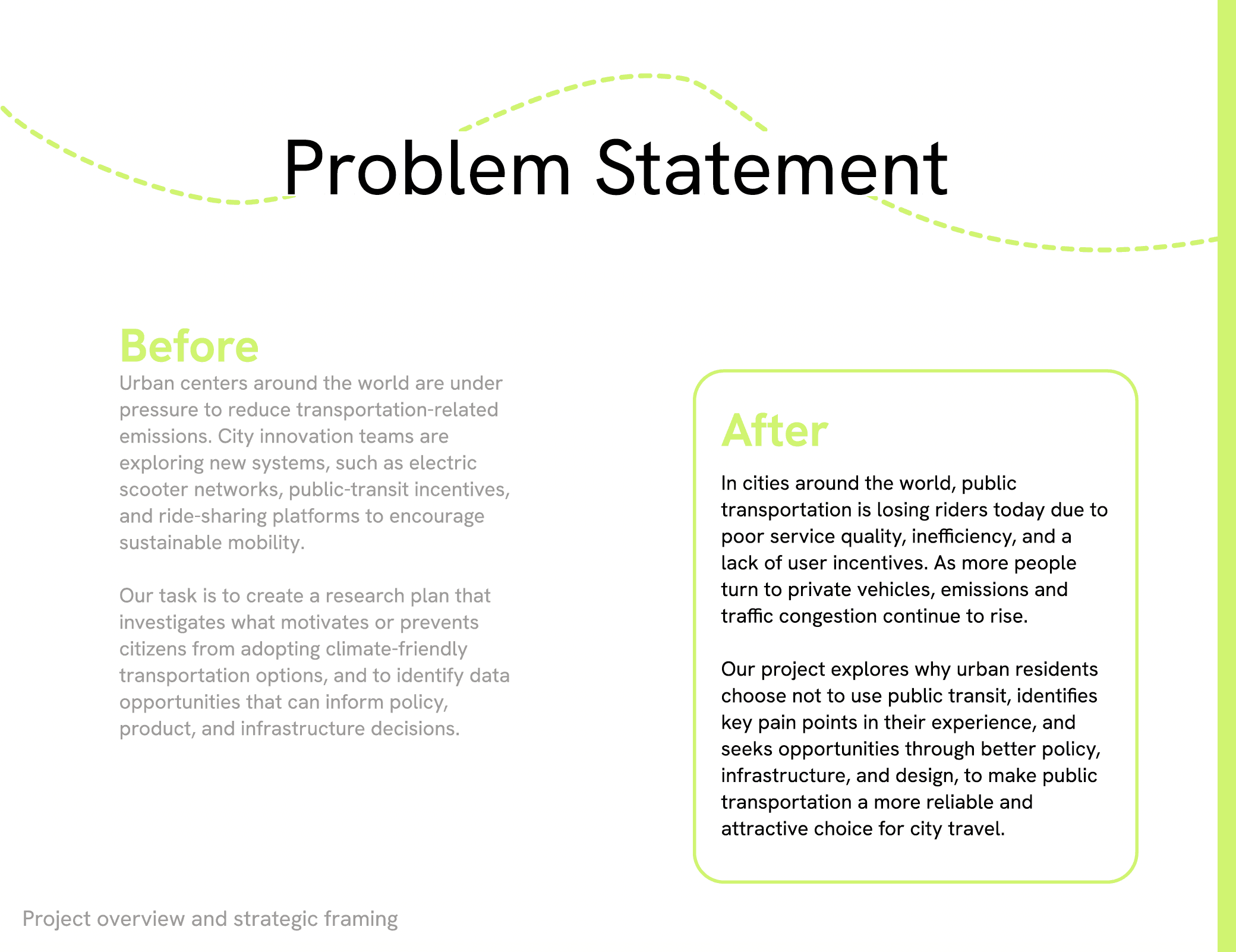
This research project investigates the factors that motivate or prevent citizens from adopting climate-friendly transportation options in urban centers. This study identifies how poor service quality and inefficiency cause public transit to lose riders to private vehicles, despite the significant environmental and financial benefits of sustainable mobility. The project ultimately seeks to identify data-driven opportunities in policy, infrastructure, and design to transform public transportation into a more attractive, reliable, and trustworthy choice for daily city travel.
The Strategic Problem
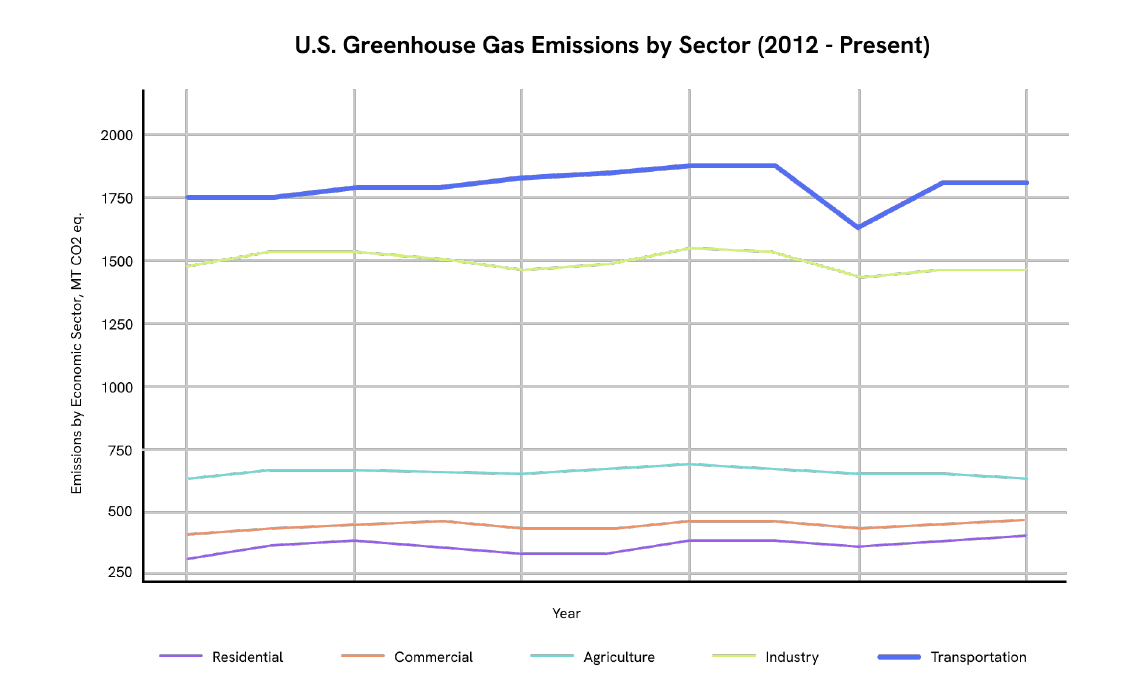
Urban centers are under intense pressure to reduce transportation-related emissions, yet public transit is losing the battle to private vehicles. While cars burn 74x more fuel and release 30x more CO2 than buses, the daily pain points of late buses and poor service quality outweigh these environmental benefits for the average rider. The core issue is a "Macro vs. Micro" disconnect: the city’s long-term sustainability goals are failing to fix the rider’s immediate, daily problems.
Research Methodology
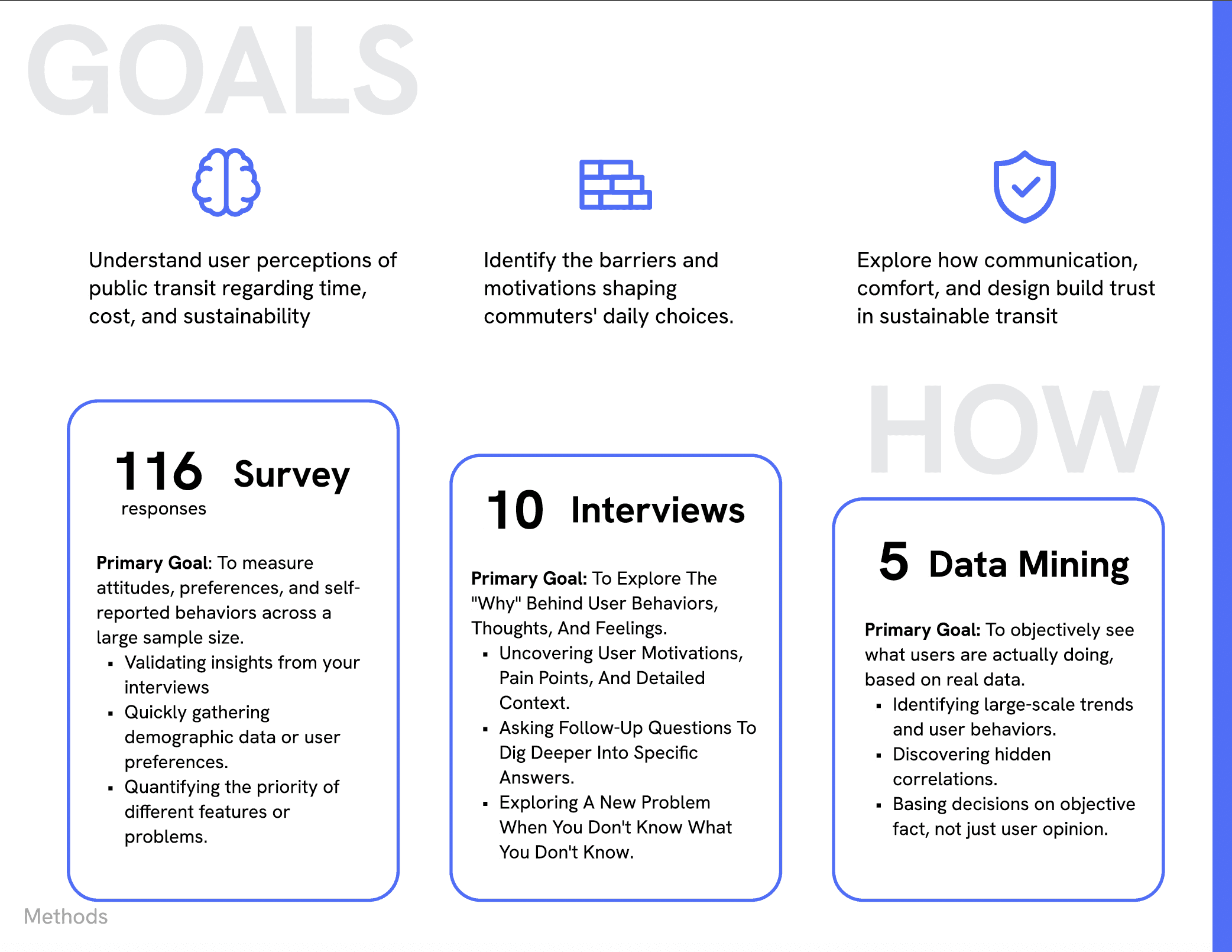
To bridge this gap, a multi-modal research plan was executed to quantify behaviors and uncover deep motivations. We collected survey data from 10+ countries to measure attitudes and prioritize feature importance across a large sample size. This was supplemented by interviews to dig into the "why" behind user feelings and data mining methods to identify objective trends and hidden correlations in actual commuter behavior.
Qualitative Themes & Trust
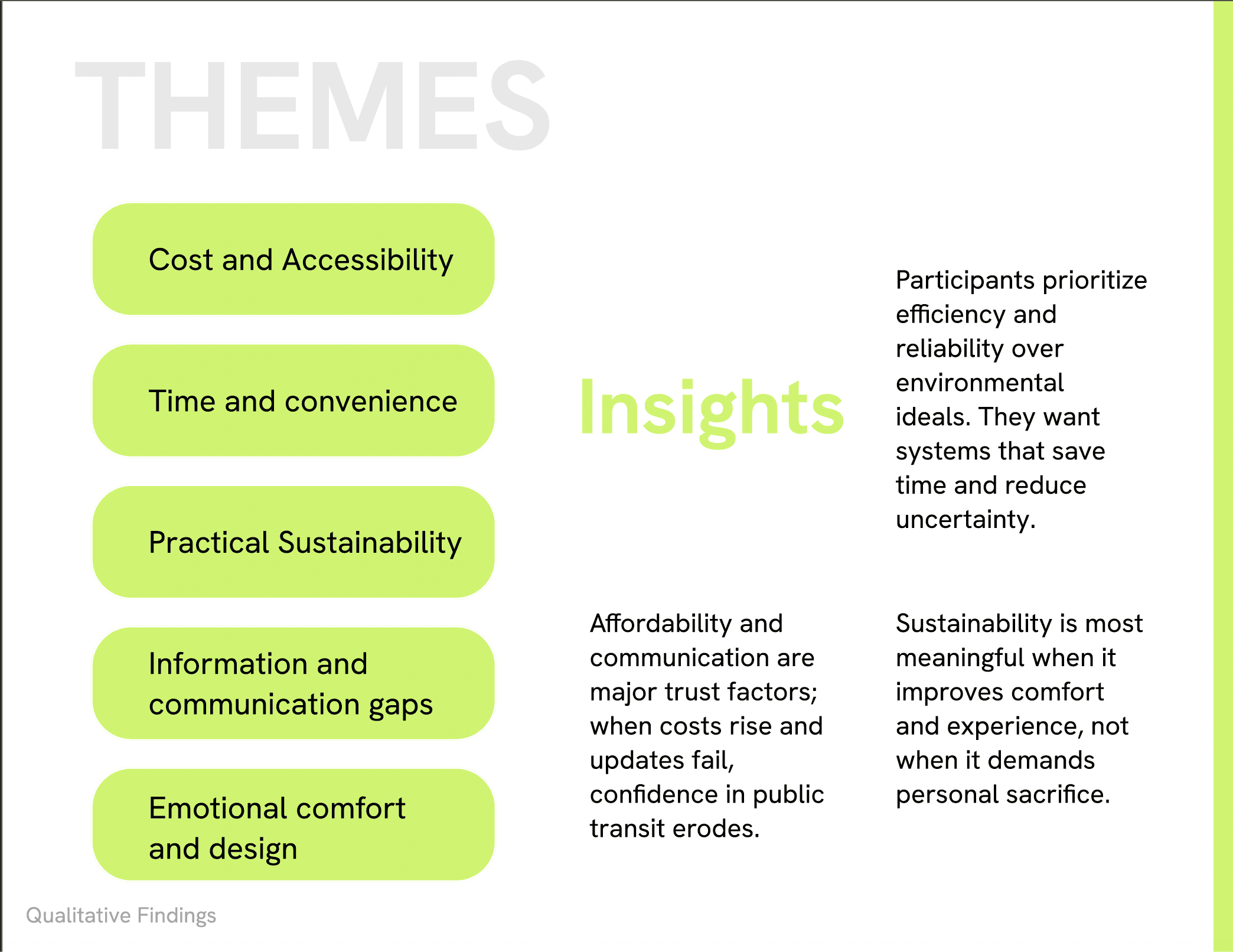
Our qualitative findings revealed that users are not driven by environmental ideals, but by a need to reduce uncertainty. Sustainability is viewed as a "bonus" that is only meaningful if it improves personal comfort without demanding sacrifice. Trust in public systems is highly fragile; confidence erodes rapidly when costs rise or when communication gaps, such as inaccurate arrival information, occur during the transit experience
The Commuter Paradox
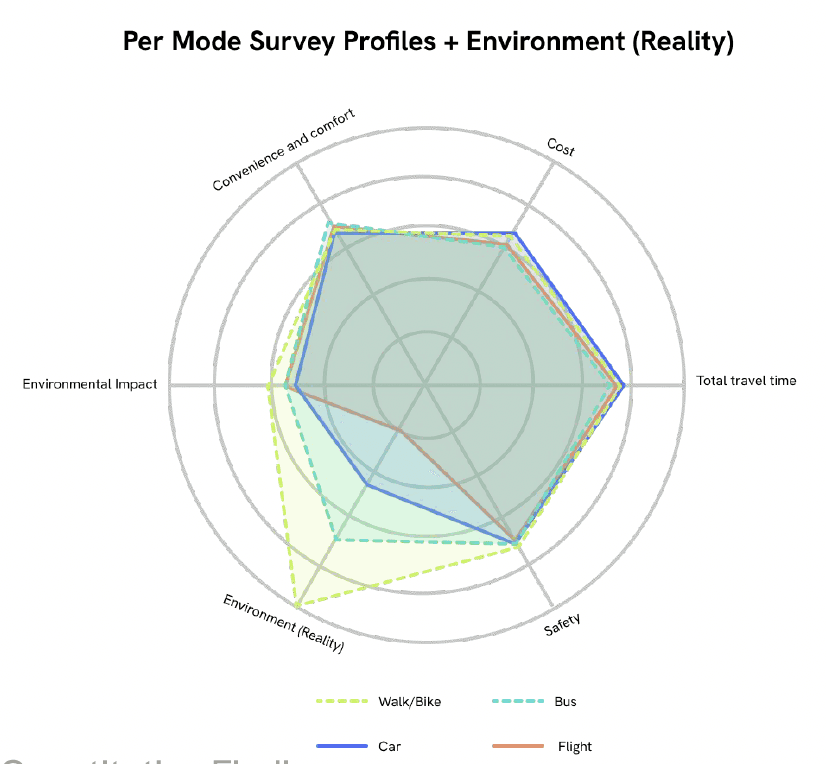
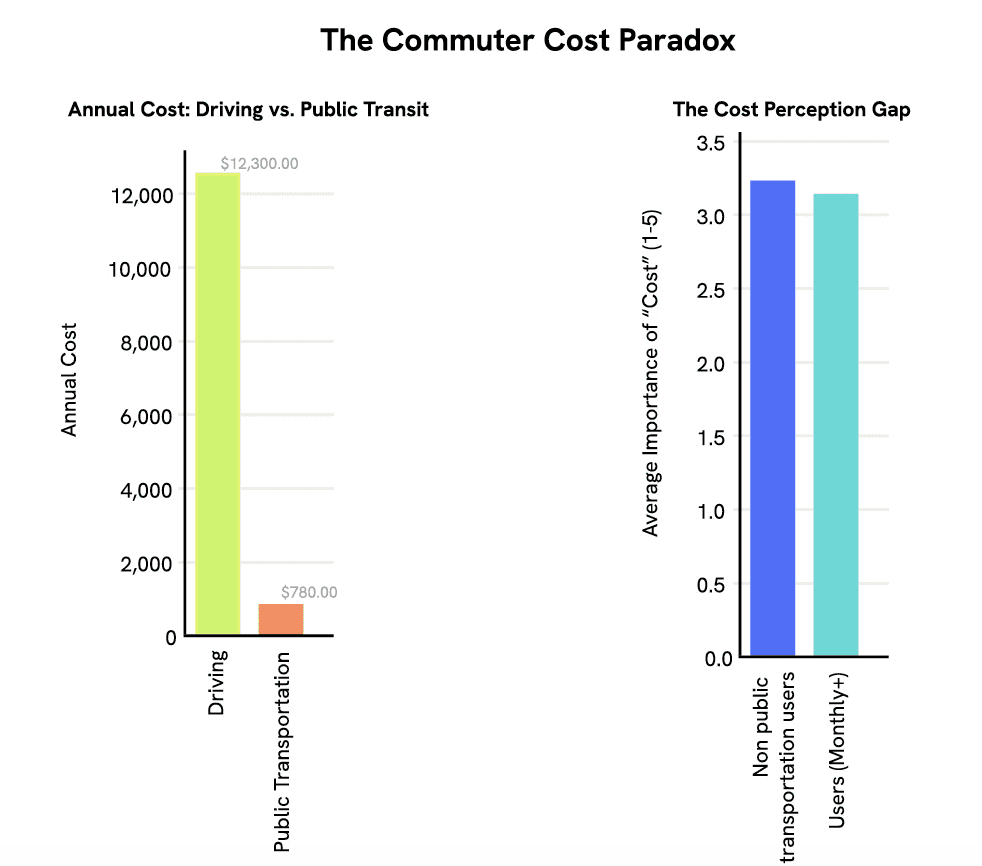
Quantitative data highlighted a massive "Cost Perception Gap". While public transportation offers a staggering annual savings of over $11,500 compared to driving, the broken user experience of transit has turned the car into a "premium experience" that users feel is worth the financial burden. Data confirms that users perceive driving as significantly superior in convenience, comfort, and safety, overriding the logical financial advantage of transit.
Design Vision & Opportunities
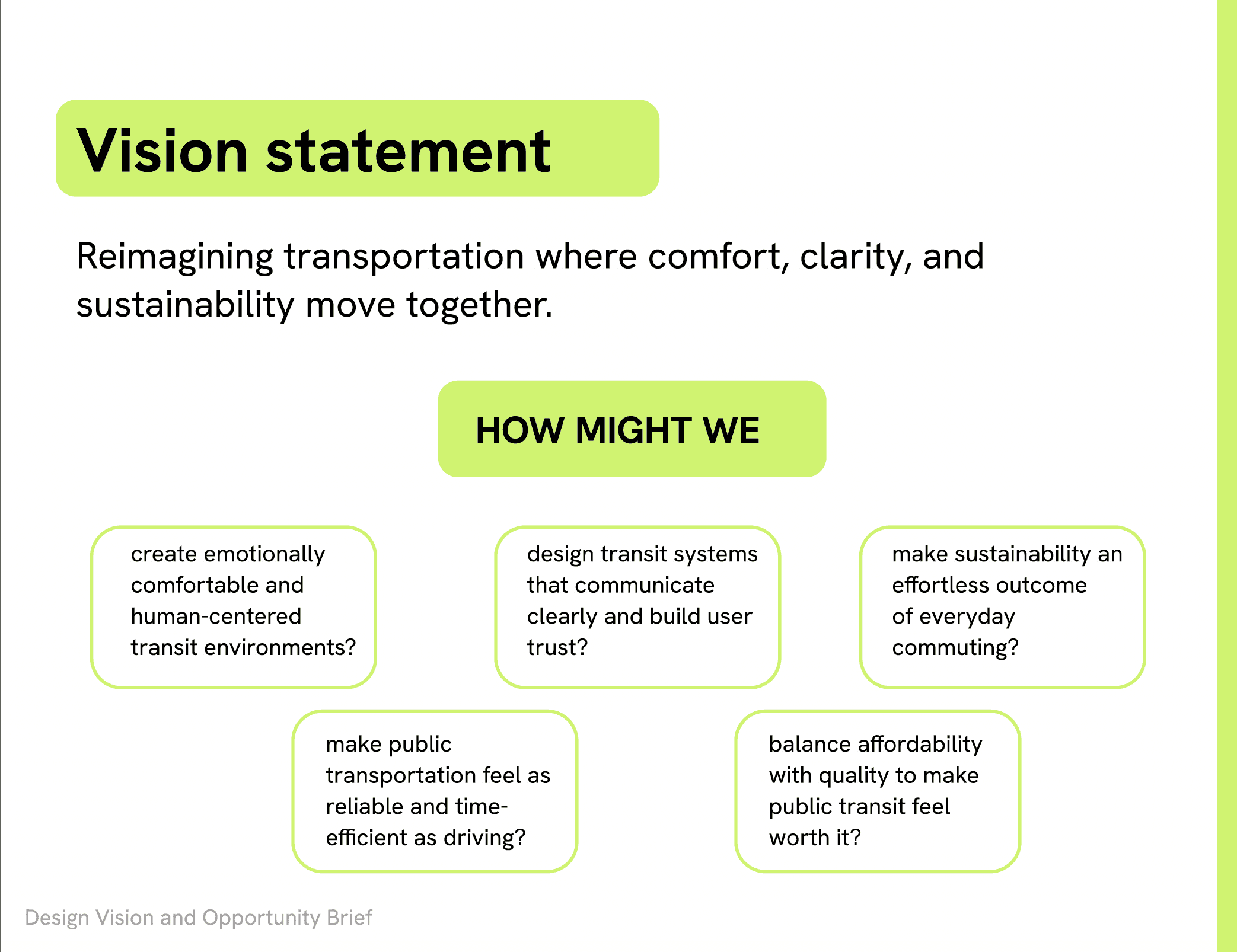
The project concludes that strategy must pivot from marketing "low cost" to fixing "convenience". Our vision is to reimagine transportation as a space where comfort, clarity, and sustainability move together. Future design opportunities include creating emotionally comfortable, human-centered transit environments and building systems that communicate clearly to ensure public transit feels as reliable and time-efficient as a private vehicle.